
Sex Offender Checks in Carson City
Carson City is an independent consolidated municipality and Nevada county-equivalent. That structure makes the local search path more direct than it may first seem. Nevada State Police maintains the Nevada Public Sex Offender Registry. The Carson City Sheriff's Office, or CCSO, serves as the local law-enforcement and registration agency. One office therefore handles the local questions that might otherwise go to a city police department or county sheriff in another place.
Use the state registry for a current public search. Use Carson City OffenderWatch when ongoing notice near a saved address matters. The U.S. Department of Justice national search adds records from participating jurisdictions outside Nevada. CCSO is the right contact when a Carson City profile seems wrong or someone may not be following registration duties. These channels complement one another. None acts as a general criminal-history report, and none can show people whom Nevada law excludes from public display.
Nevada Registry Conditions for Carson City
The public search begins behind a conditions gate. Read the Nevada registry Conditions of Use before accepting it. The notice explains the database's public-safety purpose, limits, and rule against harassment or threats. It also warns that data may change. A profile is a record of registration facts, not proof that a person is now committing an offense.
The official conditions screen shows why a Carson City registry search starts with scope, not a name box.
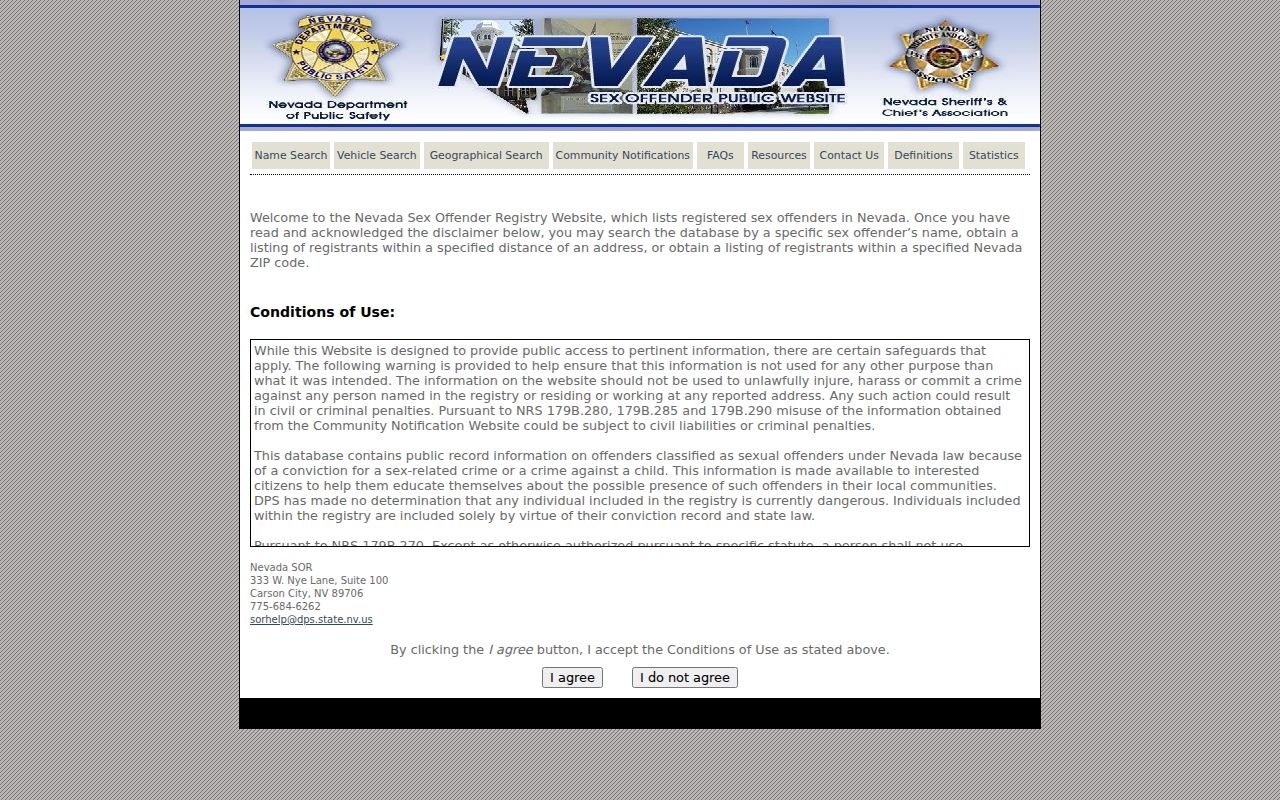
Accepting the notice leads to the search routes, but its cautions still govern every list, map, and profile that follows.
How to Search the Nevada Public Sex Offender Registry
The Nevada Public Sex Offender Registry supports three distinct queries. A name route fits a known person. The address route measures distance from a street location. A ZIP search returns a broader postal-area view. A Carson City ZIP is not the same as the legal boundary of the consolidated municipality, so describe a result by the route and radius the portal used.
- Open the official registry, read the Conditions of Use, and accept the acknowledgement.
- Choose name, address, or ZIP based on the facts already known. Add a radius when using the address-distance route.
- Review the list or map and compare official details. A map pin may be approximate.
- Open a likely profile and confirm its status, tier, permitted address data, and offense details before drawing conclusions.
- Save the same location in Carson City OffenderWatch when ongoing notice within one mile would help.
- Use NSOPW for cross-state reach, and report suspected Carson City noncompliance to CCSO without confronting anyone.
The official registry search screen makes the available Carson City sex offender search routes visible in one place.
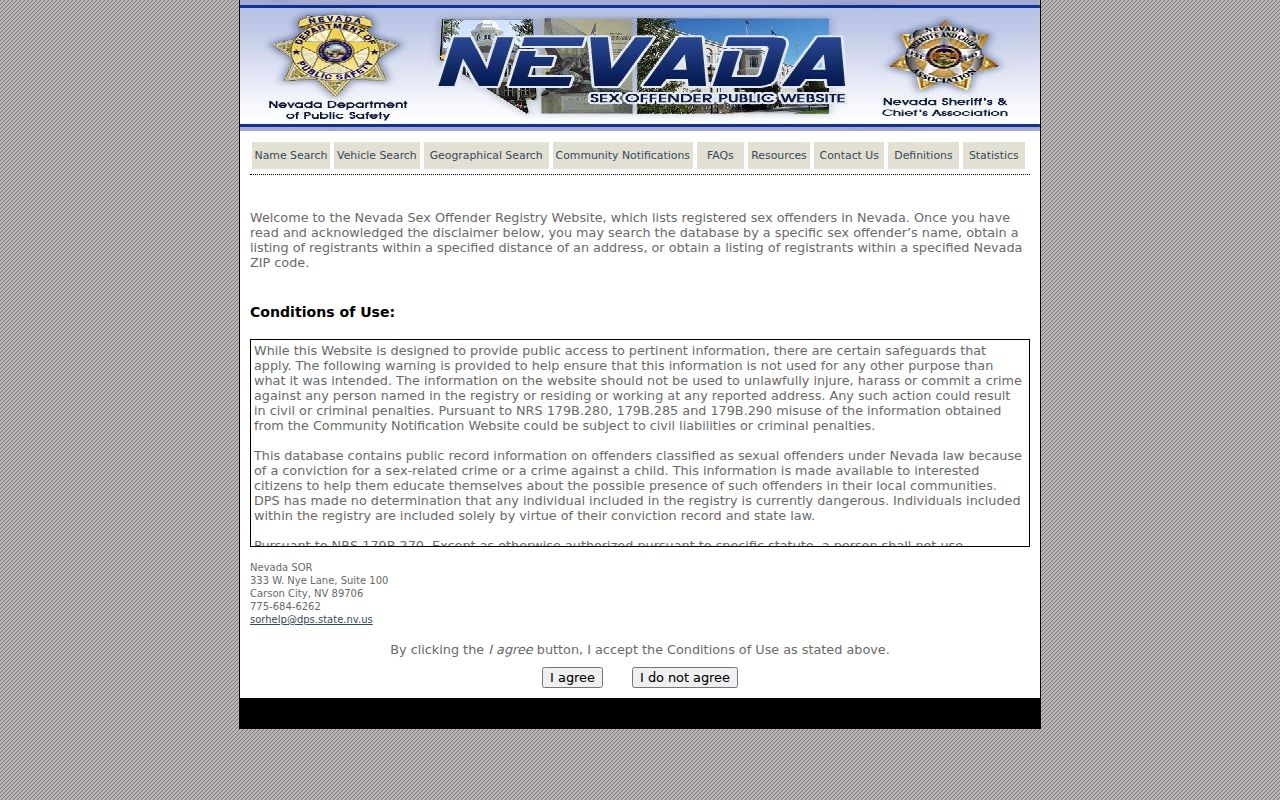
Each route answers a different question, so a no-match in one route does not rule out a useful result from another.
| Field or Control | Type | Required | Use |
|---|---|---|---|
| Conditions acknowledgement | Button or checkbox | Yes | Opens the public search after the user accepts the terms |
| Search by Name | Tab with first and last name | Chosen route | Looks for a known person |
| Search by Address | Street, city or ZIP, and radius | Chosen route | Finds public results within the selected distance |
| Search by ZIP Code | Nevada ZIP | Chosen route | Returns a broader postal-area listing |
| Results, map, and list | View controls | No | Changes how available matches are reviewed |
Carson City OffenderWatch Alerts
Manual searches give a point-in-time view. Carson City OffenderWatch adds ongoing notice. CCSO says a person may save any number of addresses without a fee and receive email when a newly registered offender appears within one mile. Both the email address and monitored locations are confidential. A family may track a home, school, park, or relative's address without forcing all places into one map search.
An alert means a registration entered the chosen one-mile area. It does not necessarily mark a new conviction or prove that a move happened on the email date. Reopen the state profile for the latest context. Notification data can also lag a source update, so the alert and the public registry should be read together rather than treated as duplicate tools.
Note: OffenderWatch watches saved Carson City addresses, while the state registry remains the source for profile details and present search results.
Inside a Registry Profile
Nevada's public profile organizes identity, registration, and offense data allowed by law. Its fields may include aliases, a photo, physical descriptors, age, marks or tattoos, tier, compliance status, registration jurisdiction, and selected location or vehicle details. Offense fields may name a statute, conviction place and date, or victim-age category. Availability varies with the legal rules for that record.
| Name and aliases | Public identity names associated with the registry entry |
|---|---|
| Photo and description | Photo plus sex, race, height, weight, hair, eyes, age, and identifying marks when public |
| Location fields | Residence or other address information that NRS 179B.250 permits the public profile to display |
| Offense details | Offense or statute, conviction jurisdiction and date, and victim-age category when public |
| Tier and jurisdiction | Nevada classification and the agency or jurisdiction tied to registration |
| Status and added fields | Compliance status plus school, work, or vehicle data when legally available |
Read the fields as official data, not as a prompt to republish a person's identity. An address update or status change does not establish a new crime. If a field conflicts with reliable first-hand facts, give CCSO the concern instead of trying to settle it through contact at the listed place.
Why Carson City Registry Matches Vary
A no-match does not amount to universal clearance. Nevada does not publicly display Tier I registrants whose victims were adults. Search spelling, the chosen radius, address changes, postal boundaries, and the timing of agency updates can affect other results. The portal also cannot identify every person ever convicted of a sexual offense, predict conduct, or guarantee that no registrant is near a searched location.
The Nevada RCCD's official record-sealing information also helps separate registry visibility from ordinary criminal-record access.
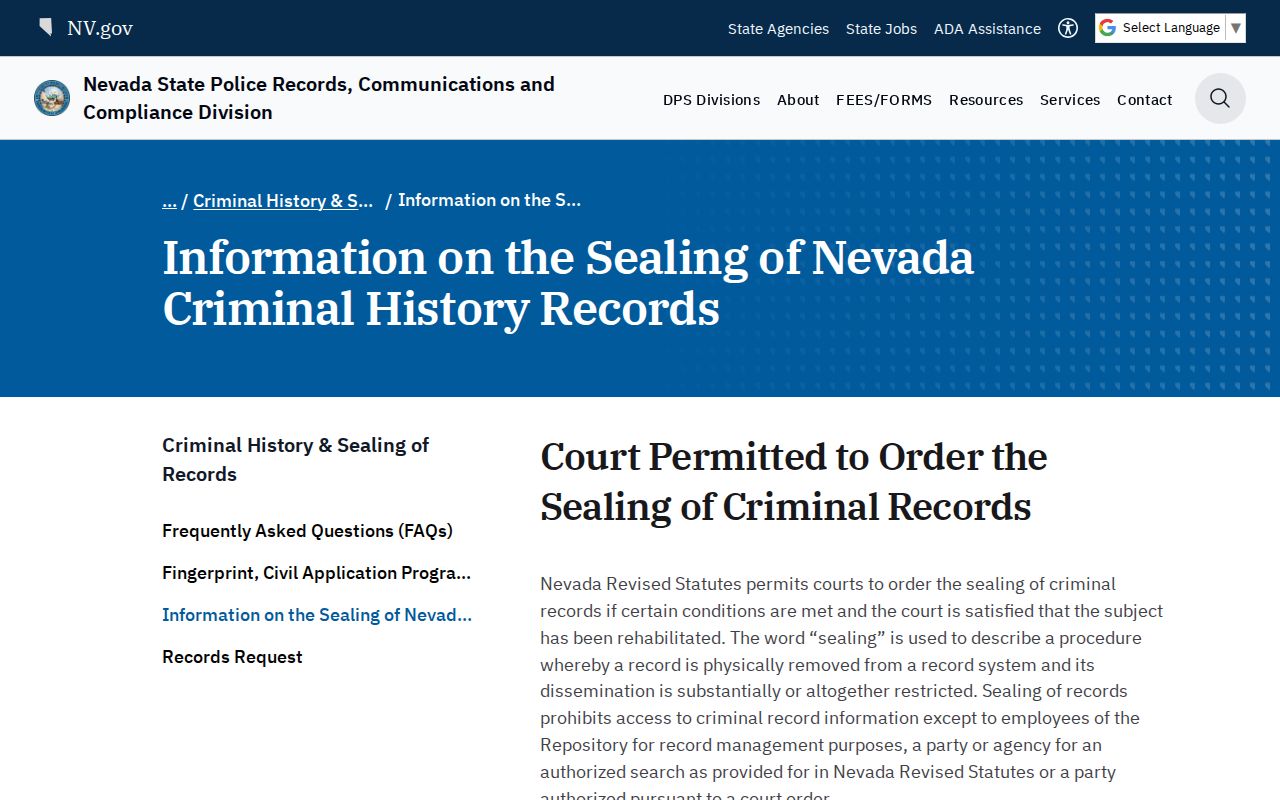
A sealed criminal-history record and a statutory registration duty are distinct legal issues, so never infer one from the other without an official source.
Nevada Registration Levels and Requirements
Nevada uses three statutory tiers. A tier is a legal category based on the qualifying offense and related rules, not a score based on public opinion. The broad periods and verification cycles below are an orientation. Comparable out-of-state or federal offenses, custody time, tolling, statutory relief, and later changes in law can alter a specific person's calculation.
The current NRS Chapter 179D registration law supplies the controlling definitions and exceptions.
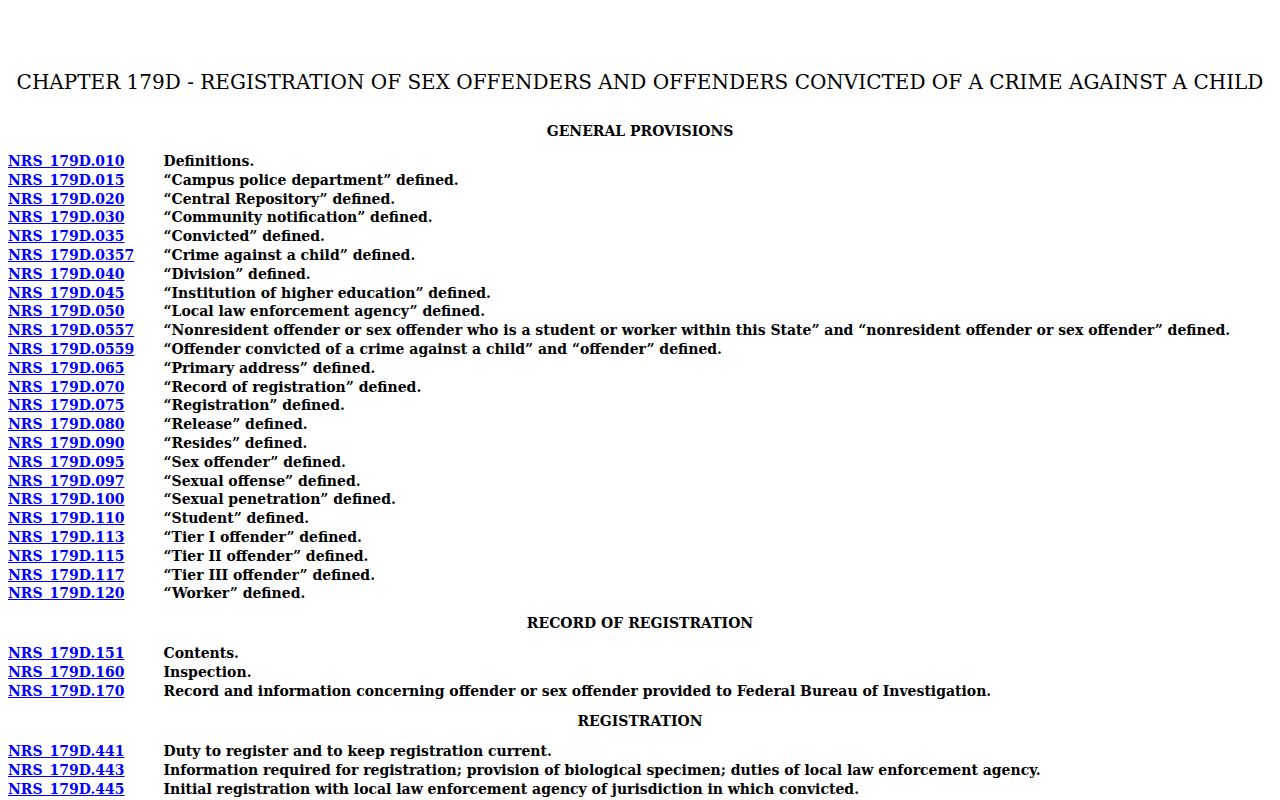
The statute is the right place to check offense-specific tier rules when a profile's brief label does not answer a duration question.
| Tier | General Duration | Verification | Public-Portal Note |
|---|---|---|---|
| Tier I | Generally 15 years; a statutory reduction may apply | Annual | Tier I adult-victim records are omitted from public display |
| Tier II | Generally 25 years | Semiannual | Public visibility follows Nevada law |
| Tier III | Lifetime | Quarterly | Covers the most serious or repeat statutory categories |
Carson City Registry Across State Lines
The Nevada portal, Carson City OffenderWatch, and the national search each work at a different scale. Nevada provides the state's source profiles. OffenderWatch monitors local addresses over time. The National Sex Offender Public Website, or NSOPW, searches participating jurisdictions when a concern crosses Nevada's border.
The federal NSOPW screen shows the broader layer available beyond a Carson City registry search.
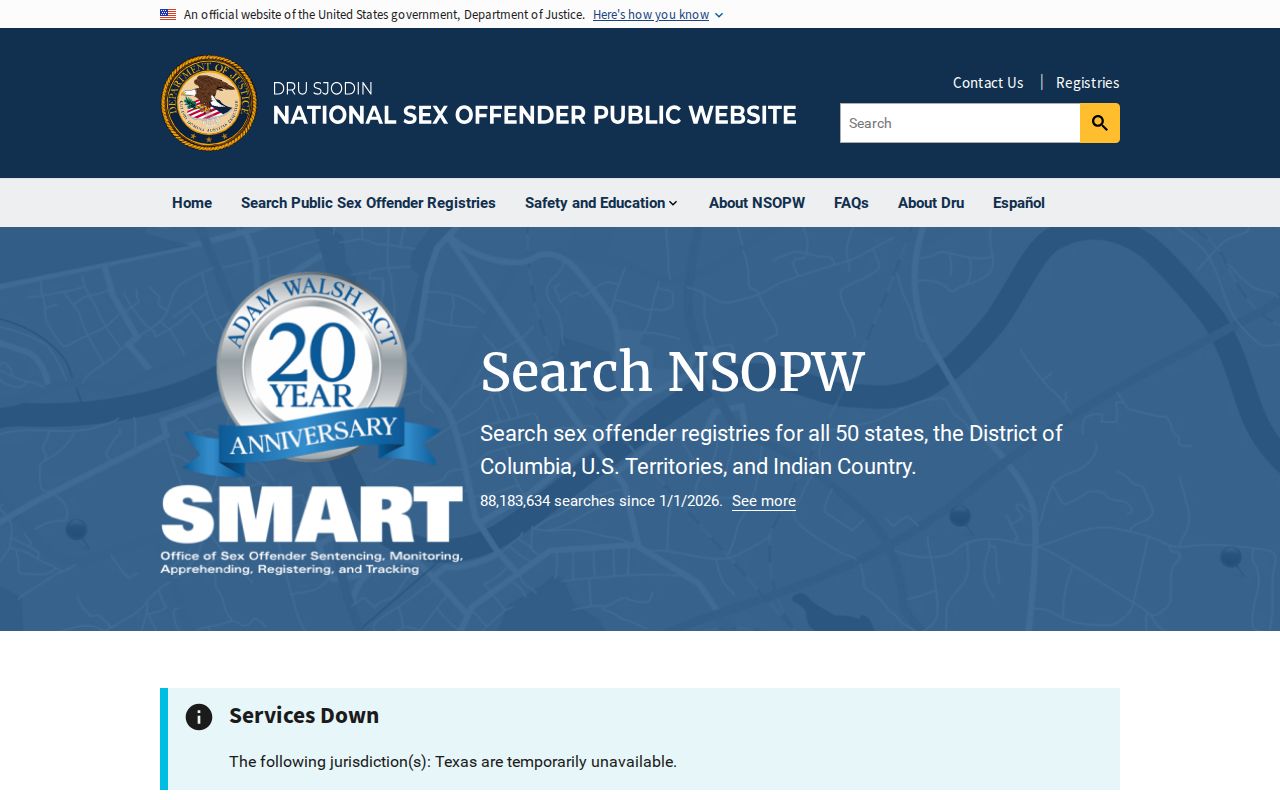
NSOPW depends on data supplied by source registries and on the terms entered. It adds reach but does not replace Nevada's profile, CCSO's local role, or a direct report when data appears stale.
Reporting Carson City Registry Concerns
CCSO performs Carson City's registration and verification work from 911 East Musser Street. Nevada State Police maintains the statewide public system. That split explains why the portal is the first stop for a search, but the Sheriff's Office is the contact for possible local noncompliance or an address that looks out of date. Use the CCSO contact channel and nonemergency dispatch at (775) 887-2677. Call emergency services only for an immediate danger.
Give the agency the official profile and the specific field at issue. Do not go to the displayed address, attempt surveillance, confront a person, or publish private details. A map pin may be approximate, and a postal address near a boundary can be easy to misread. The agency can compare the report with registration records and determine what follow-up is lawful.
Community Notification and Lawful Use
Registry information supports personal, family, and community awareness. Lawful use starts with the limits stated at the conditions gate. A profile cannot prove present misconduct or forecast what someone will do. A displayed residence is a statutory data field, not an invitation to visit. For continuing awareness in Carson City, OffenderWatch is safer and more useful than repeated observation of an address.
The warning is backed by the registry's Conditions of Use and Nevada's registration framework. NRS Chapter 179D governs registration and public notification, while NRS 179B.250 limits the information that may be placed in the public profile. The research does not identify one special registry-misuse penalty statute, so threats, harassment, and other conduct remain subject to the Nevada criminal or civil law that applies to the act.
Use registry data lawfully: Nevada's registry warns against harassment or threats, and misuse can be a crime under the Nevada law applicable to the conduct. Never confront a registrant or household.
Community notice works best when official channels stay distinct. Search the state registry for present public fields. Save local addresses in OffenderWatch for new-registration emails. Use NSOPW for other jurisdictions. Bring suspected Carson City noncompliance to CCSO. That sequence keeps the response tied to source records and trained officials.