
Checking Criminal History in Carson City
There is no public portal that returns a complete Carson City criminal history for any typed name. Start by defining the question. Current custody belongs with the Carson City jail search. An agency narrative belongs with the arresting agency. Formal charges and the result belong with the proper court clerk. A Nevada resident who needs their own fingerprint-linked state record must use the Nevada State Police Records, Communications and Compliance Division, known as RCCD.
Names, aliases, date ranges, case or report numbers, and the type of document sought help the custodian find the right Carson City record. A name alone can produce a false match or miss an older file. Use the narrowest official source first, then compare the result with the court disposition when an arrest or charge is involved.
- Use the current Carson City inmate search when the question is present jail custody.
- Ask CCSO Civil and Records for an eligible incident report, booking record, or local criminal-history letter.
- Route a court request by its suffix: a 1B case goes to District Court, while a 1C case goes to the Justice/Municipal clerk.
- Compare the filed charge, plea, disposition, and judgment instead of treating the booking allegation as the outcome.
- For a personal Nevada record, submit the fingerprint packet to RCCD; use the FBI channel separately for a nationwide identity history.
Four Carson City Record Custodians
One Carson City arrest can create four records at four offices. The arresting agency writes the incident narrative. The detention facility makes the booking entry. A court clerk opens a case if prosecutors file a charge. RCCD later groups fingerprint submissions and reported dispositions into the subject's Nevada history. Those records can use different charge words and update on different schedules.
Use this split as a source map, not as proof that one file is wrong. A booking shows intake allegations and present custody. A docket shows what was filed and how the court handled it. A rap sheet links Nevada arrest cycles with dispositions reported to the repository. The Carson City criminal court case record is the best place to read the formal outcome.
| Record | Carson City source | Best evidence |
|---|---|---|
| Incident report | Arresting agency | Event narrative and agency action |
| Booking entry | CCSO Detention | Intake, holds, bail, and custody |
| Court file | Justice/Municipal or District clerk | Filed charges, hearings, and disposition |
| Nevada history | RCCD Records Bureau | Fingerprint-linked Nevada cycles |
Nevada Official Background Checks
Nevada does not offer an unrestricted public name search through its central repository. The official subject-access route is the RCCD record request channel. The subject sends an original rolled ten-print FD-258 card, the DPS-006 form, and an exact $27 money order or certified check. The packet produces the subject's Nevada record or a no-record notice, not a report about any person chosen by the requester.
A certified fingerprint technician at a law-enforcement agency or authorized private service must take the prints. RCCD states that processing runs within 30 calendar days plus mailing time. Each person needs a separate packet and fee. Nevada's result excludes other states and the FBI record, while a CCSO local letter is narrower because it contains only local agency data.
The Nevada Records Bureau overview shows the state repository's role in Carson City criminal history. The screen below reinforces that a state record is an official request product, not an open people-search tool.
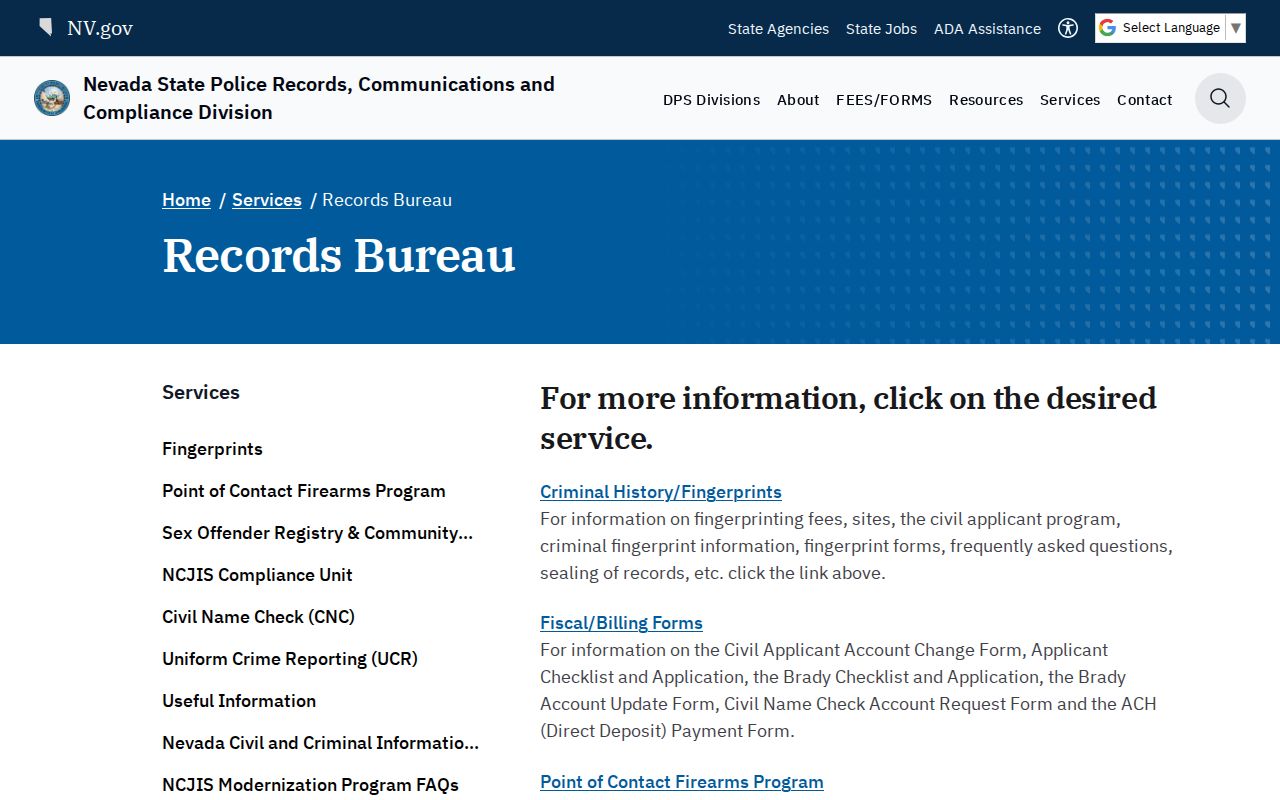
RCCD receives fingerprint cards from Nevada law-enforcement agencies and later depends on reported court outcomes to complete each arrest cycle.
Carson City Civil and Records
CCSO Civil and Records is the local repository for sheriff case reports, booking information, and local criminal-history letters. The counter is within the sheriff complex at 911 East Musser Street. Requests may go to ccsorecords@carsoncity.gov, but every request requires valid government identification. Eligibility turns on the case status and the requester's involvement, so not every narrative is released to every person.
Routine reports are normally complete within five to ten business days after the event. Detective and coroner matters may remain unavailable for weeks, and a local history letter can take up to 30 days. Payment is due before release. CCSO lists cash, money order, and cashier's check as accepted forms, with checks or orders payable to the Carson City Sheriff's Office.
CCSO Civil and Records
911 East Musser Street
Carson City, NV 89701
(775) 887-2500
ccsorecords@carsoncity.gov
Carson City Courts
885 East Musser Street
Carson City, NV 89701
(775) 887-2082
District on floor 3; lower courts on floor 2
Nevada RCCD
333 West Nye Lane, Suite 100
Carson City, NV 89706
(775) 684-6262
State subject records
Criminal Record Types
Carson City criminal records describe different steps, not one permanent file. CCSO or another arresting body writes an incident report. The Carson City Detention Facility creates a booking record. Prosecutors then decide whether to file a complaint, information, or indictment. The clerk records motions, hearings, pleas, orders, and the final judgment. RCCD links Nevada fingerprint events and reported outcomes in a separate repository record.
Warrant, supervision, prison, and registry data also have distinct custodians. A wanted page cannot confirm every warrant. Alternative Sentencing and the Nevada Division of Parole and Probation hold different supervision records. NDOC tracks state-prison custody, and the Nevada Public Sex Offender Registry publishes only the statutory subset Nevada law permits.
- Booking
- Jail intake that records identity, charges, property, photograph, fingerprints, and custody data.
- Complaint
- A sworn charging allegation that often begins a lower-court criminal case.
- Disposition
- The operative result for a charge or case, such as dismissal, conviction, or acquittal.
- Record sealing
- A court restriction that removes qualifying records from ordinary access without erasing every authorized copy.
Carson City Custody Record Paths
The correct custody source depends on the stage. The CCSO-linked inmate interface is for people shown in current Carson City jail custody. The jail line at (775) 283-5245 is the fallback if a person was released, transferred, or has not appeared online. Nevada VINE at (888) 268-8463 supports custody information and notifications. These tools do not prove a conviction.
After a state-prison sentence and transfer, use the Nevada Department of Corrections Inmate Search. Federal custody belongs with the Bureau of Prisons locator. A person missing from the Carson City roster may have been released or moved; the next sound step is a phone check, court search, or written booking request, not a conclusion that no arrest occurred.
After custody is located, the RCCD records request hub supplies the separate Nevada subject-record and challenge channels.
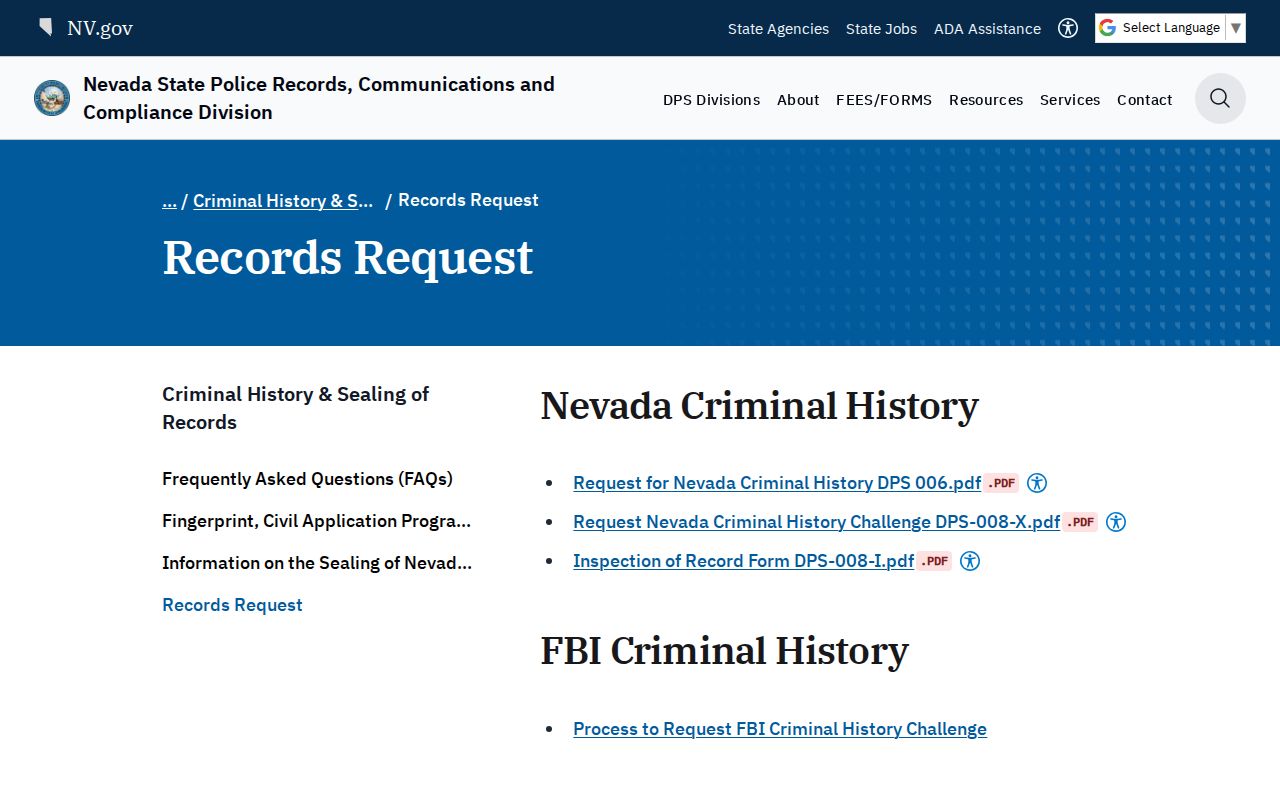
The RCCD page does not replace the jail or NDOC locator; it routes a person to their fingerprint-based state record and correction forms.
Inside a Carson City Criminal Record
A Nevada rap sheet starts with identity information and then groups activity into arrest cycles. It can list aliases, fingerprint identity, arrest date, submitting agency, charges, and later disposition data. Court and custody records add different fields. Read each field in light of the office that created it and the date it was last checked.
Public court copies redact Social Security numbers, financial-account data, protected victim or minor information, and other confidential identifiers. A blank or redacted field is not proof that no information exists. It may mark a legal access limit.
| Name and identifiers | Legal name, aliases, date of birth descriptors, and fingerprint-linked state identifier. |
|---|---|
| Arrest and booking | Arrest date, agency, tracking number, intake time, hold, bail, and release status. |
| Charges | Alleged offense, statute citation, and class, which can change after prosecutor review. |
| Disposition | Plea, dismissal, acquittal, conviction, or other outcome reported for each count. |
| Sentence | Custody, probation, fines, restitution, and related court orders. |
| Supervision | Probation, parole, institution, and release information when held by that source. |
Carson City Court Suffix Routing
Carson City's public-records instructions use a direct suffix rule. Send a case ending in 1B to districtcourtclerk@carsoncity.gov. Send a 1C matter to JusticeCourtClerk@carsoncity.gov. First Judicial District Court keeps felony and gross-misdemeanor files on the courthouse's third floor. Justice and Municipal Court administration is on the second floor, but those two legal roles are not identical.
Justice Court handles misdemeanors, initial appearances, and felony preliminary stages. Municipal Court handles city ordinance matters. The court request form asks for the case number or name, search years, requested documents, certification, delivery preference, and requester contact data. Its listed record search fee is $0.50 per year per name. Older files should be framed with both a name and a year range.
The Census QuickFacts profile confirms the consolidated Carson City geography that makes this two-floor court and city system unusual.
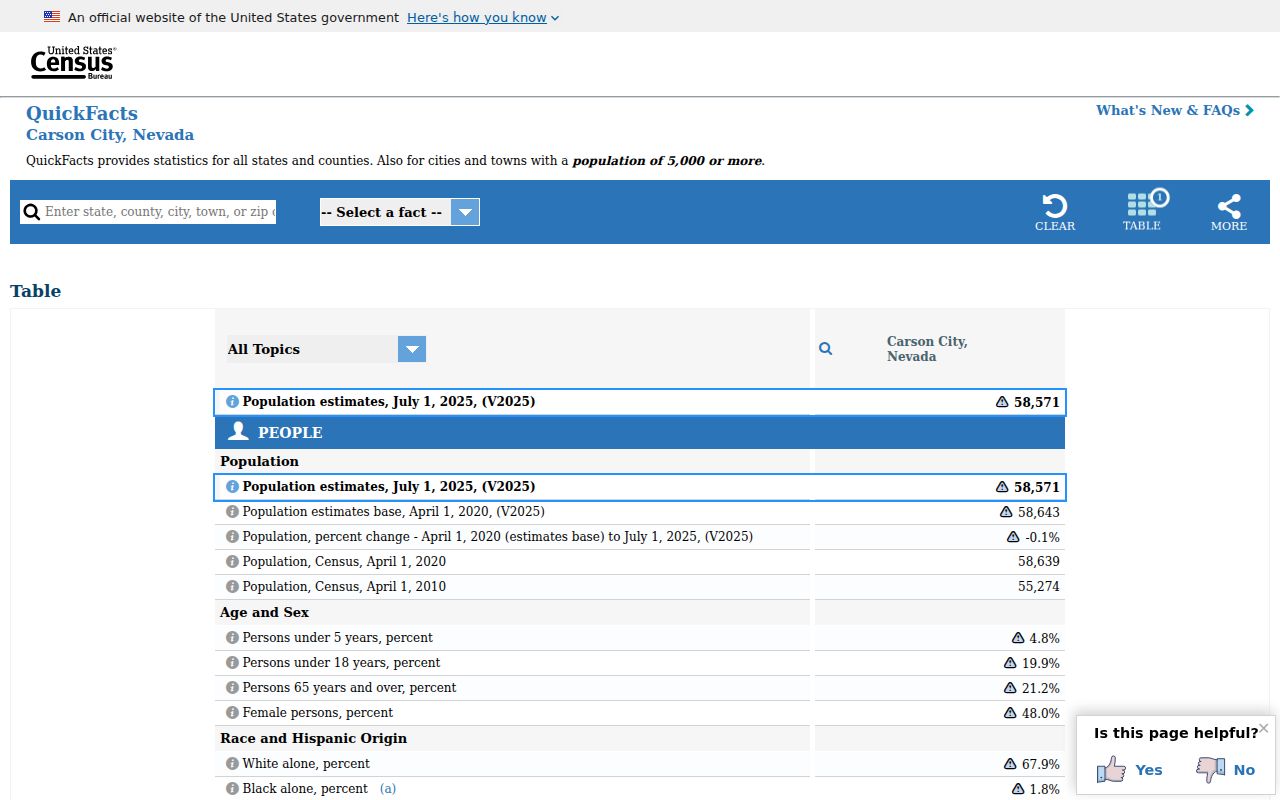
The population shown for Carson City is also the county-equivalent population; it should not be counted again as a separate county figure.
Public Access Laws in Nevada
The Nevada Public Records Act makes governmental records open unless another law declares them confidential. NRS 239.0107 generally requires the custodian to provide the record or written notice about delay or confidentiality by the end of the fifth business day. That is a response rule, not a promise that a large Carson City request will be produced in five days.
NRS Chapter 179A separately controls criminal-history collection and dissemination. It allows a person to inspect repository information about themselves, while excluding investigative or intelligence material and refusing to create a public search-anyone system. Juvenile records, sealed matters, protected identities, and active-investigation details may be withheld or redacted.
Key Nevada laws:
NRS 239.010 and 239.0107 set the public-record presumption and the custodian response process.
NRS 179A.100 and 179A.150 govern criminal-history dissemination and a subject's inspection right.
NRS 179.240 and 179.285 address sealing eligibility and the legal effect of an order.
NRS Chapter 179D establishes Nevada registration tiers and duties.
Carson City Walk-In Record Inspection
Carson City residents have a rare local option because RCCD is headquartered on West Nye Lane. A subject may present DPS-008-I and government identification to inspect their own Nevada repository record in person. The inspection route does not permit notes, photographs, copies, or removal of the record. Anyone who needs a copy must use the fingerprint submission and DPS-006 instead.
This difference matters when planning a correction. A person who spots a missing disposition should obtain the certified court result, identify which custodian holds the error, and use the matching process. The court corrects its docket under court rules. CCSO handles its report and booking data. RCCD provides the formal challenge route for repository data. One correction request does not automatically repair every downstream copy.
The Nevada Public Records Act text is an official source for Carson City public access rules.
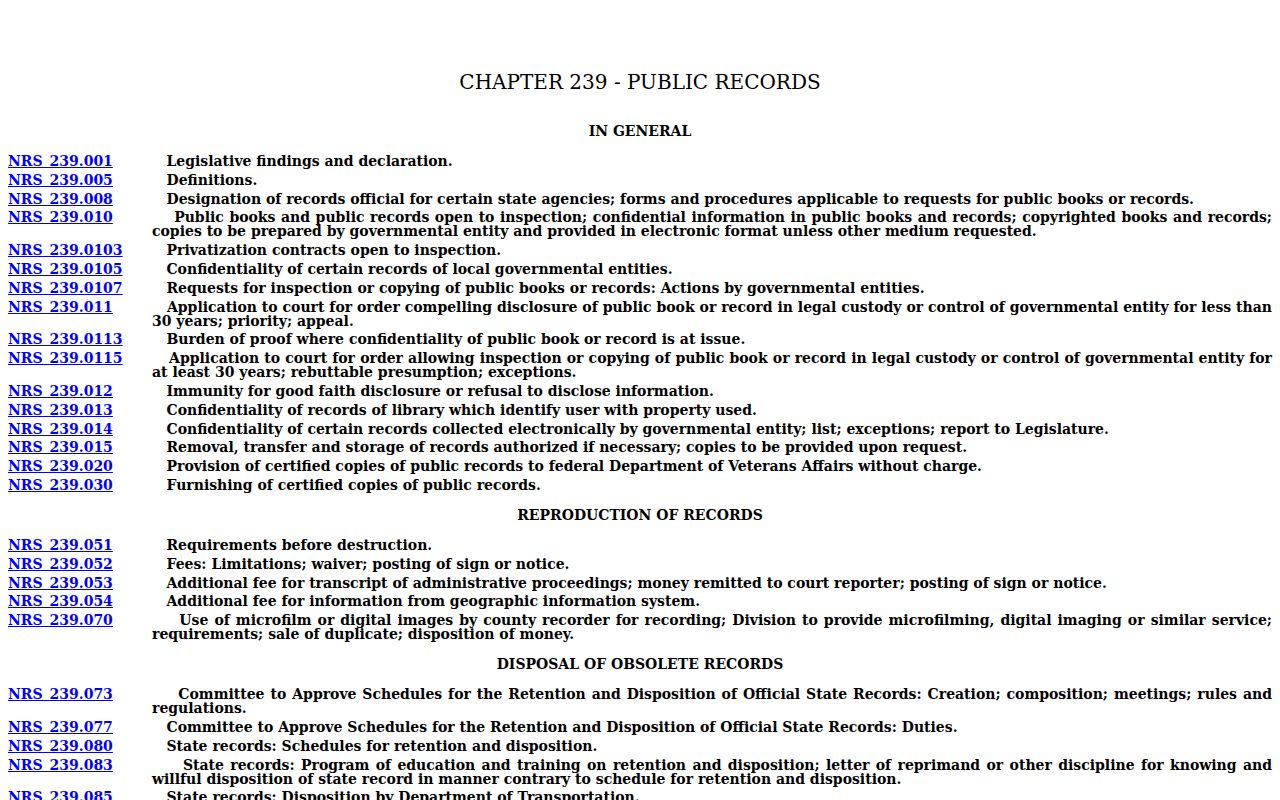
The statute helps define the custodian's response duty, but it does not override the separate confidentiality rules that protect criminal-history and investigative data.
Sealed, Expunged, and Restricted Records
Nevada's remedy is record sealing. Baseline waits under NRS 179.240 run after release from custody, discharge from supervision, or sentence completion, whichever is later. The period varies by offense. Many category B through D felonies use a seven-year baseline, category E felonies and gross misdemeanors generally use two years, and most misdemeanors generally use one year. Offense-specific exceptions and permanently ineligible records require the current statute.
A Carson City petition starts with the subject's Nevada history and the local arrest and disposition records. The filer prepares the petition, proposed order, and agency list; contacts the Carson City District Attorney for local instructions; files in the court with jurisdiction; serves required recipients; and distributes certified signed orders to RCCD and every agency that knows of the arrest. Sealing restricts ordinary access but does not physically erase every authorized record.
Juvenile files, protected victim data, active investigations, and sealed cases can also be absent from an ordinary search for reasons that have nothing to do with system failure. If a sealed item remains visible, send the order to the source and challenge the appropriate record instead of assuming all systems sync at once.
Carson City Warrant Confirmation
CCSO's Crime in Our Area page includes wanted-person information, but the research does not support treating it as a complete real-time warrant database. Confirm a possible warrant with CCSO nonemergency or the court that issued it. Justice or Municipal Court can address lower-court bench warrants, while the District Court clerk can check a warrant tied to a 1B case.
A written records request may reach releasable warrant material, but search warrants, sealed indictments, and juvenile warrants can remain nonpublic. Absence from a wanted list does not clear a person. If a warrant is confirmed, ask the issuing court about the case, bond, and appearance process before acting on general web advice.
Note: A court text is not an official First Judicial District case notice; call the clerk independently instead of using a message link.
Carson City Criminal Records by City
Carson City has one incorporated and consolidated municipality, so there is one city guide. The Sheriff's Office is also the municipal police agency, and city arrests normally enter the CCSO jail rather than a separate police lockup. Justice and Municipal Court share administration while keeping distinct jurisdiction. Neighborhoods such as Empire and Lakeview are not separate incorporated cities and do not get stand-alone record pages.
Carson City Criminal Records
58,571 estimated residents in 2025 · CCSO serves as police, sheriff, coroner, records office, and jail.
Carson City Justice Record Context
Carson City is Nevada's capital and a 144.53-square-mile county-equivalent. Its courthouse, sheriff complex, state repository, Supreme Court, Legislature, State Archives, corrections administration, and Parole Board sit within the same capital area. The physical closeness can help a records search, but the offices remain separate custodians. Walking from the courthouse at 885 East Musser Street to CCSO at 911 East Musser Street does not turn a court request into an incident-report request.
CCSO's January 2026 NIBRS report counted 193 Group A offenses and 93 clearances, with a reported 49 percent clearance measure. Those are one-month operational figures, not an annual crime rate. The report used its own local population estimate and should not be casually compared with a different UCR summary. The useful lesson for a Carson City criminal record search is that offense totals, arrest files, filed cases, and convictions measure different events.
The local system also has records outside the usual path. Justice and Municipal Court run a weekly Mental Health Court. The detention facility's Family Services Unit works with incarcerated parents, caregivers, children, and community partners on case management and reentry. These programs can create court, supervision, or program records with access rules different from the public docket.
Carson City's courthouse site also carries an older justice link. Abraham Curry's Great Basin Hotel once stood there and housed Nevada's first Supreme Court. That history helps explain the capital's dense civic corridor, but present-day access still follows the modern custodian named on each record.